


Pultrusion Molding Resin Feeding Equipment Guide
2025-12-08 12:45:28In the pultrusion molding process, the quality of “impregnation” — how thoroughly resin coats the continuous reinforcing fibers — directly dictates the final profile’s mechanical properties and long-term reliability. Pultrusion molding resin feeding equipment is the precision executor of this critical step. It is responsible for delivering the resin system (e.g., epoxy, polyester, vinyl ester, or polyurethane) to the fiber reinforcement accurately, uniformly, and consistently, rightfully earning its title as the “heart” of the entire pultrusion line.
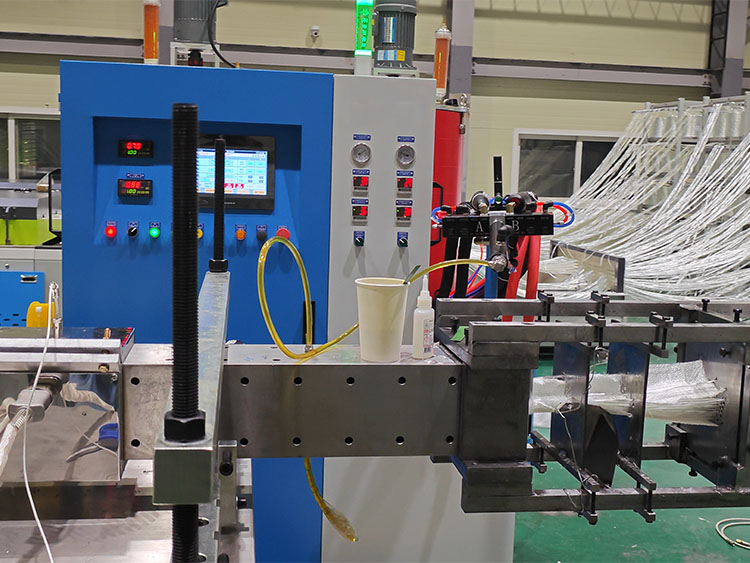
1. Core Function: Precision Engineering Beyond “Feeding”
The core mission of this equipment extends beyond mere resin delivery to enabling a controlled, repeatable precision impregnation process. It must ensure:
Accurate Ratios: Constant, precise mixing ratios for two or multi-component resins.
Complete Impregnation: Full encapsulation and penetration of every fiber strand, eliminating “dry spots”.
Process Stability: Highly consistent flow, pressure, and mix quality over hours or days of continuous operation.
Material Adaptability: Capability to handle various resin systems, from low to high viscosity, and from neat to highly filled formulations.
2. Analysis of Core Technical Modules
An advanced resin feeding system typically consists of several core modules working in concert:
1. High-Precision Metering & Dispensing Module
Core Components: Employs servo-driven high-precision metering pumps (e.g., gear pumps, progressive cavity pumps) for independent closed-loop control of resin and hardener flow.
Key Spec: Mixing ratio control accuracy up to ±0.5%, ensuring batch-to-batch consistency in cured resin performance.
Extended Function: Can integrate a third channel for adding color paste, additives, or internal release agents.
2. Efficient Mixing & Degassing Module
Static Mixing Technology: Primarily uses low-pressure-loss, high-efficiency static mixers. Resin and hardener are instantaneously and homogeneously mixed at a molecular level as they pass through internally designed helical elements, with no moving parts and minimal maintenance.
Vacuum Degassing System (Optional): Provides in-line vacuum degassing of the resin before it enters the impregnation bath, significantly reducing entrapped air, which is essential for producing high-end, low-porosity profiles.
3. Temperature Control & Delivery Module
Full-Line Temperature Management: Precise temperature control (accuracy ±1-2°C) via circulating fluid or electric tracing for resin tanks, delivery lines, and mix head maintains optimal resin viscosity for stable flow and mixing.
Stable Delivery: Real-time monitoring via pressure and flow sensors ensures a smooth, pulse-free resin supply to the impregnation bath or direct injection system.
4. Intelligent Control & Data Management Module
Central Control System: Industrial PLC with touchscreen HMI for unified control of all metering, mixing, temperature, and cleaning sequences.
Recipe Management & Traceability: Stores hundreds of product recipes for one-touch changeover. Logs and stores all critical process parameters (ratio, temperature, pressure, flow) for full quality traceability.
Automatic Cleaning Function: Initiates a cleaning cycle with one touch after production to quickly purge the mixer and lines, increasing equipment utilization.
3. Primary Impregnation Methods & System Configuration
The resin feeding equipment must be matched with the chosen fiber impregnation method:
Open Bath Impregnation: The equipment delivers mixed resin steadily to an open bath where fibers pass through. The system must maintain a stable bath level and resin freshness.
Injection Chamber Impregnation (Direct Injection): The equipment injects resin directly into a closed chamber where fibers are impregnated under pressure. This method places high demands on the equipment’s output pressure, flow stability, and response speed, significantly reducing resin exposure/VOC emissions and improving impregnation quality.
4. Key Application Fields
This equipment is fundamental for producing various high-performance pultruded profiles, widely used in:
New Energy: Solar panel mounting structures, wind turbine blade stiffeners.
Infrastructure & Transportation: Bridge components, guardrails, utility poles, light rail platforms, automotive structural parts.
Electrical & Consumer: Cable trays, insulating ladders, ladder rails, tool handles.
5. Selection Considerations & Value
When selecting resin feeding equipment, focus on:
Metering accuracy and long-term stability, the root of quality consistency.
Compatibility with your target resin system (viscosity, fillers, reactivity).
System reliability and automation level to reduce operator dependence and ensure continuous production.
The supplier’s process understanding and technical support capabilities.
GOOGIO Machinery's pultrusion resin feeding solutions integrate high-precision metering, efficient static mixing, and intelligent temperature control. We are committed to providing our customers with a stable, reliable, and efficient “heart” unit, empowering their pultrusion lines to produce the highest quality composite profiles.
Looking to enhance the impregnation quality and stability of your pultrusion line? Contact us for a professional solution.