


Complete Analysis of the Pultrusion Resin Injection Process
2026-02-06 13:51:15The pultrusion resin injection process is an advanced composite material forming technique, primarily used for manufacturing high-performance, high-fiber-content composite profiles. Below, I will provide a detailed breakdown of its process flow, core advantages, key parameters, and application areas.
I. Process Overview
The traditional pultrusion method is "open-bath impregnation," where fibers are drawn through an open resin bath. In contrast, the "pultrusion resin injection process," also known as injection pultrusion or closed-mold pultrusion, is an enhanced technique. Its core distinction lies in directly injecting the mixed resin under pressure into a sealed mold cavity, where it thoroughly impregnates the continuously moving fiber reinforcement.
This process addresses issues inherent to open-bath impregnation, such as resin volatilization, styrene emissions, and uneven saturation. It is particularly suited for products demanding high performance, environmental compliance, and superior working conditions.
II. Process Flow (Step-by-Step Breakdown)
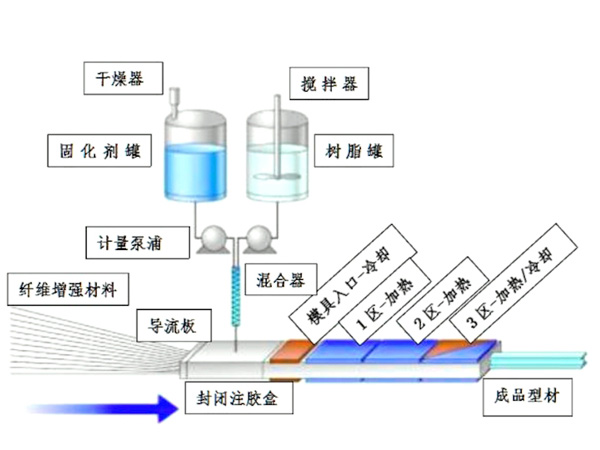
The entire operation is continuous and automated, as illustrated in the following diagram:
Raw Material Preparation
Reinforcement Materials: Primarily continuous roving of glass, carbon, or basalt fibers. Depending on mechanical property requirements, continuous mats, stitched fabrics, or multiaxial textiles may be added to enhance transverse strength.
Resin System: Typically low-viscosity, highly reactive resins such as unsaturated polyester, vinyl ester, or epoxy. The resin must be precisely mixed with hardeners and promoters.
Fiber Guidance and Alignment
Fibers are drawn from creels and guided through a series of alignment plates to achieve the precise layup structure specified by the product design, ensuring they enter the mold straight and uniformly.
Preforming
The aligned fiber bundles pass through one or more preforming dies. These dies compact the loose fibers into a preform approximating the final product shape while expelling excess air, preparing the material for resin injection.
Resin Injection and Impregnation (Core Step)
The preform enters the front section (injection zone) of the main forming die, which is a sealed cavity.
A precise metering-mixing-injection system injects the uniformly mixed resin under pressure into the mold cavity through injection ports.
Through careful mold design (featuring tapers and flow channels) and capillary action within the fibers, the resin thoroughly impregnates the fiber bundles, flowing from the inside out and from the center to the periphery. The internal mold pressure ensures the expulsion of air bubbles, achieving exceptional impregnation quality.
Gelation and Curing
The resin-impregnated composite enters the heated curing zone of the die.
The die is precisely temperature-controlled (often with multiple zones). As the material is pulled through, the resin undergoes cross-linking, transitioning from liquid to solid and finally taking on the desired profile shape and dimensions.
Continuous Pulling
The puller provides the continuous, steady tensile force that draws the entire material from the creels, through the die, and to the cut-off station. Pulling methods include caterpillar and reciprocating clamp systems.
Post-Curing Cooling
The cured profile exits the die at an elevated temperature and may pass through a cooling system (air or water) to stabilize dimensions and facilitate handling.
Cut-to-Length
The continuous product is cut to predetermined lengths by a synchronized cutting machine, such as an automatic circular saw.
Finished Product Handling
The cut profiles are collected, inspected, and packaged.
III. Core Process Advantages
Superior Fiber Impregnation Quality: High-pressure injection effectively removes air bubbles, ensures uniform saturation, minimizes internal defects, and delivers higher, more consistent mechanical properties, particularly interlaminar shear strength.
Higher Fiber Volume Content: Can reach 70% or more, resulting in superior product strength and stiffness.
Exceptional Environmental Performance: Fully closed-mold operation drastically reduces emissions of volatile organic compounds (VOCs) like styrene, significantly improving the working environment.
Excellent Surface Quality: Curing within a sealed mold produces profiles with smooth surfaces, precise dimensions, and a uniform resin-rich layer.
Reduced Material Waste: Resin is injected on-demand, eliminating the volatilization and dripping associated with open baths, thereby minimizing loss.
Enhanced Flexibility: Allows for rapid changes in resin formulation or color by simply cleaning the injection system, avoiding the need to drain large resin baths.
IV. Key Process Parameters and Control
Resin Injection Pressure and Flow Rate: Must be synchronized with pull speed, fiber content, and resin viscosity to ensure complete impregnation without resin starvation or overflow.
Mold Temperature: Critical for the curing reaction. Multiple temperature zones (preheat, gel, cure) must be set according to the resin system, as the temperature profile directly impacts production speed and product performance.
Pull Speed: Directly related to resin cure time and is a core parameter determining production efficiency.
Fiber Tension: Maintaining uniform and appropriate tension ensures fibers remain straight and properly aligned within the die.
V. Primary Application Areas
This process is especially suitable for manufacturing high-performance, demanding composite profiles:
Wind Energy: Critical load-bearing components for wind turbine blades, such as spar caps, shear webs, and fairing strips.
Rail Transportation: Window frames, interior profiles, and conductor rail covers for high-speed rail and subway systems, requiring high flame retardancy and low smoke toxicity.
Construction Engineering: Carbon/glass fiber plates for structural strengthening, bridge components, and grating systems.
Electrical & Power: High-voltage insulating ladders, crossarms, and cable trays.
Aerospace: Secondary structural components, such as brackets and rods.
Summary
The pultrusion resin injection process represents a significant trend in pultrusion technology's evolution toward higher performance, environmental sustainability, and automation. By shifting from "bath impregnation" to "pressure injection," it fundamentally enhances product quality and production cleanliness. It stands as an indispensable key process for manufacturing premium composite linear products.