


AB Ratio Inconsistent? The Real Culprit Isn't Your Operator.
2026-01-12 11:20:05If you produce potted or encapsulated components, you've likely faced this frustrating scenario: using the same AB adhesive and the same skilled operator, but ending up with a batch where some parts are rock hard, others are tacky, or worse, never fully cure. Rework, scrap, and customer complaints pile up. The first instinct is often to blame the "bad batch" of material or the operator's "off day." However, the true culprit is usually something less visible: inconsistent mixing ratios.
Why is manual mixing inherently unreliable?
Tools Have Built-In Error: Our common tools—digital scales and measuring cups—have inherent limitations. A scale accurate to 1 gram cannot measure the 0.5-gram difference critical for a 100:28.5 ratio. This "tiny" error is enough to compromise the chemical cure.
Humans Aren't Robots: Misreading a scale, a shaky hand while pouring, or rushing and not scraping the mixing cup clean—any minor variation introduces an imbalance between the Part A and Part B that actually makes it into the product. Even the most experienced operator cannot replicate every motion with machine-like precision, hour after hour.
Material Loss is a Silent Thief: High-viscosity adhesives stick to container walls and mixing paddles. This "wasted" material silently skews the carefully calculated ratio. In high-volume production requiring multiple mixes, these small errors compound into major inconsistencies.
So, how does a proper two-component dispensing machine solve this fundamental problem?
The principle is straightforward: replace error-prone human senses and actions with precise, automated "mechanical organs."
The "Heart" – Precision Metering Pumps: Instead of "scooping" material, the machine uses servo-driven pumps that act like precise syringes. They "push" out a metered shot of Part A and Part B at your set ratio every single time. Accuracy of ±1% or better locks the ratio in a tight, repeatable range.
The "Brain" – Intelligent Control System: You simply enter the correct ratio (e.g., 100:28.5) on the touchscreen. The PLC controller takes over, orchestrating the pumps and eliminating all human guesswork and visual errorfrom the equation.
Closed-Loop Assurance – Real-time Monitoring: Advanced systems include pressure and flow sensors. If a pump deviates even slightly, the system alerts or auto-corrects, ensuring ratio consistency from the first shot to the last.
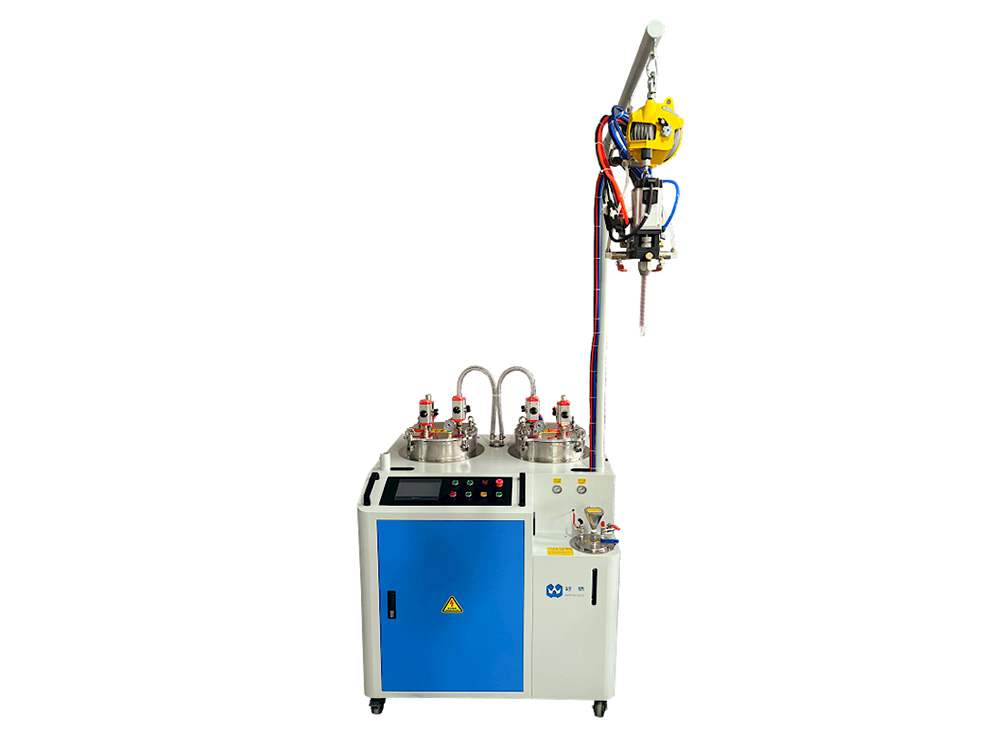
This isn't about replacing skilled people; it's about elevating their role.A good dispensing machine frees the operator from repetitive, error-prone manual tasks. It allows them to focus on higher value—managing the process, optimizing parameters, and overseeing final quality. What it solves is more than just a ratio; it's production stability, product yield, and ultimately, your company's profitability and reputation.
The next time inconsistent ratios cause trouble, consider that the solution may not be new adhesive or a new hire, but a new, more deterministic method of production. In modern manufacturing, precision that can be engineered into a machine shouldn't be left to the variables of the human hand.